Table of contents
The Weight of Competition: Understanding Pressure in Individual vs. Team Sports
When we talk about the difficulty of sports, there's often a debate about whether individual or team sports are "harder." The truth is, neither is easier—they're just fundamentally different in how they distribute pressure, responsibility, and triumph.
When we talk about the difficulty of sports, there's often a debate about whether individual or team sports are "harder." The truth is, neither is easier—they're just fundamentally different in how they distribute pressure, responsibility, and triumph.
The Sheet Cake Analogy
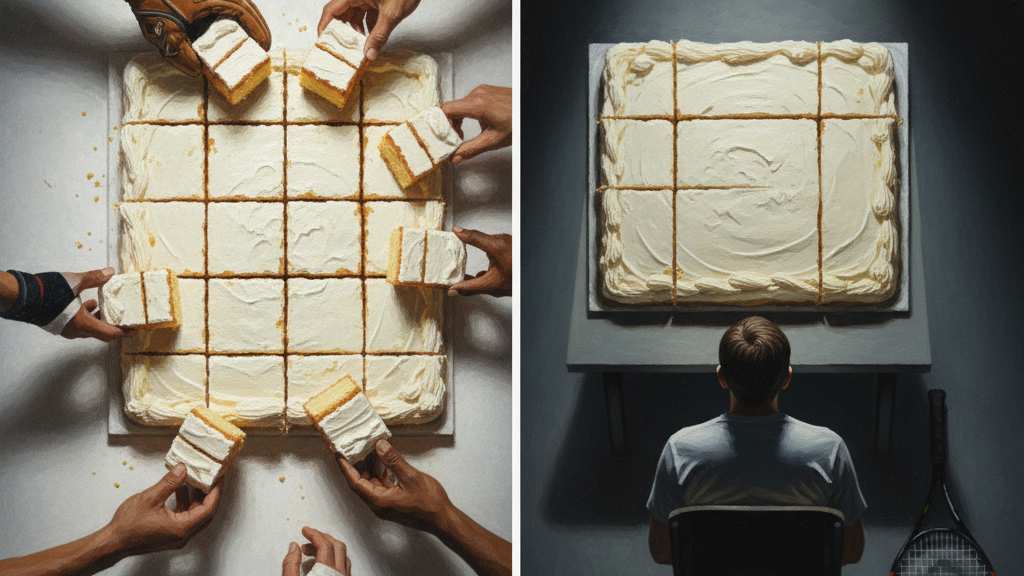
Imagine a massive sheet cake sitting on a table. In team sports, that cake represents the pressure of competition, and it gets divided among 18 teammates. Each person gets a slice—still substantial, but manageable. You can lean on your teammates when your slice feels too heavy, and they can lean on you.
In individual sports, there's no dividing that cake. You have to eat the entire thing yourself. Every ounce of pressure, every moment of competition, every decision and mistake—it all lands squarely on your shoulders. There's no one to pass to, no one to cover for you, and nowhere to hide.
Neither scenario is easier. Eating your slice perfectly while coordinating with 17 other people presents its own challenges. But consuming an entire cake alone? That's a different kind of weight entirely.
The Pressure Paradox
Team Sports: Shared Burden, Collective Accountability
In team sports, pressure is distributed but multiplied by interpersonal dynamics:
You're accountable to your teammates, not just yourself or your coach
A bad day can be compensated for by teammates stepping up
The weight of letting others down can feel crushing
Communication and chemistry add layers of complexity
Individual brilliance must serve collective success
The pressure isn't less—it's just shared. And sometimes, knowing that your mistake could cost 17 other people their victory creates its own unique psychological burden.
Individual Sports: Solitary Burden, Complete Ownership
Individual sport athletes face a stark reality:
Every win is yours alone, but so is every loss
No one can save you when you're struggling
Mental fortitude becomes paramount—you are your own hype team and your own coach in the moment
The spotlight is unrelenting—there's no bench to retreat to
You own every decision, every success, every failure
When a tennis player double-faults on match point, there's no teammate to pick up the slack. When a gymnast falls, the scoreboard reflects only their performance. The entire cake must be consumed alone.
Discipline and Commitment: Two Sides of the Same Coin
The Team Sports Athlete
Team sport athletes develop:
Selflessness and ego management—learning when to lead and when to follow
Communication skills that extend far beyond the playing field
Adaptability to coaching styles and teammate personalities
The ability to find motivation through collective goals
Resilience through shared experience—you suffer together, you celebrate together
Their discipline involves showing up not just for themselves but for every person counting on them. Practice isn't optional when your absence affects 17 others.
The Individual Sports Athlete
Individual sport athletes cultivate:
Self-reliance and internal motivation—no one else is coming to save them
Extreme mental toughness—they must be their own biggest supporter in moments of doubt
Unwavering personal accountability—every result is a direct reflection of their work
The discipline of solitude—training alone, competing alone, processing alone
Complete ownership of their development—they must identify and fix their own weaknesses
Their commitment means showing up when no one is watching, pushing through when no teammates are there to encourage them, and finding the will to continue when the entire weight of competition rests on their shoulders.
Individual Athletes Are Team Players Too
Here's what often gets overlooked: individual sport athletes are absolutely team players.
They Compete for More Than Themselves
Olympic athletes represent their countries, carrying national pride
College athletes score points for their teams in meets and tournaments
Professional golfers participate in team events like the Ryder Cup
Track and field athletes contribute to team scores at meets
Wrestlers and swimmers earn points for their school or club
They Rely on Support Systems
Individual athletes don't succeed in a vacuum:
Coaches who guide their technical and strategic development
Training partners who push them in practice
Sports psychologists who help them manage the mental load
Family and support staff who make the logistics of competition possible
Sponsors and fans who provide resources and motivation
A tennis player may walk onto the court alone, but behind them is an entire team that made that moment possible.
They Learn Teamwork Through Competition
Training groups in running, cycling, and swimming foster camaraderie
Practice partners in tennis and combat sports develop mutual respect and growth
Gym communities in gymnastics and figure skating celebrate each other's victories
The individual sport community often rallies around its members during struggles
The Mental Game: Where Both Converge
Both team and individual athletes must master:
Pressure management under scrutiny
Consistency over time
Bouncing back from failure
Staying humble in success
Balancing confidence with continuous improvement
The difference is in the echo chamber. Team athletes process pressure with immediate support. Individual athletes often process it alone, then bring lessons back to their support system.
Neither Is Easier—Just Different
The athlete diving for a loose ball in the final seconds, knowing 20,000 fans and 14 teammates are depending on them, faces immense pressure.
The athlete standing at the free-throw line with the game on the line, arena silent, faces immense pressure.
The athlete running the final leg of a relay, trying to maintain a lead, faces immense pressure.
The athlete toeing the starting line of a marathon, knowing the next 26.2 miles depend solely on their preparation and will, faces immense pressure.
None of these is easier. They're different flavors of the same fundamental challenge: performing at your absolute best when everything is on the line.
Conclusion: Respect Both Paths
The next time you watch a basketball game or a tennis match, a soccer tournament or a track meet, remember the sheet cake. Some athletes divide the pressure among teammates, navigating the complex dynamics of collective success. Others consume the entire thing alone, carrying the full weight of competition on their shoulders.
Both require extraordinary discipline, unwavering commitment, and exceptional mental fortitude. Both produce athletes who understand teamwork, even if the team looks different. And both deserve our respect and admiration for the unique challenges they face.
The question isn't which is harder. The question is: which kind of pressure would you rather carry?